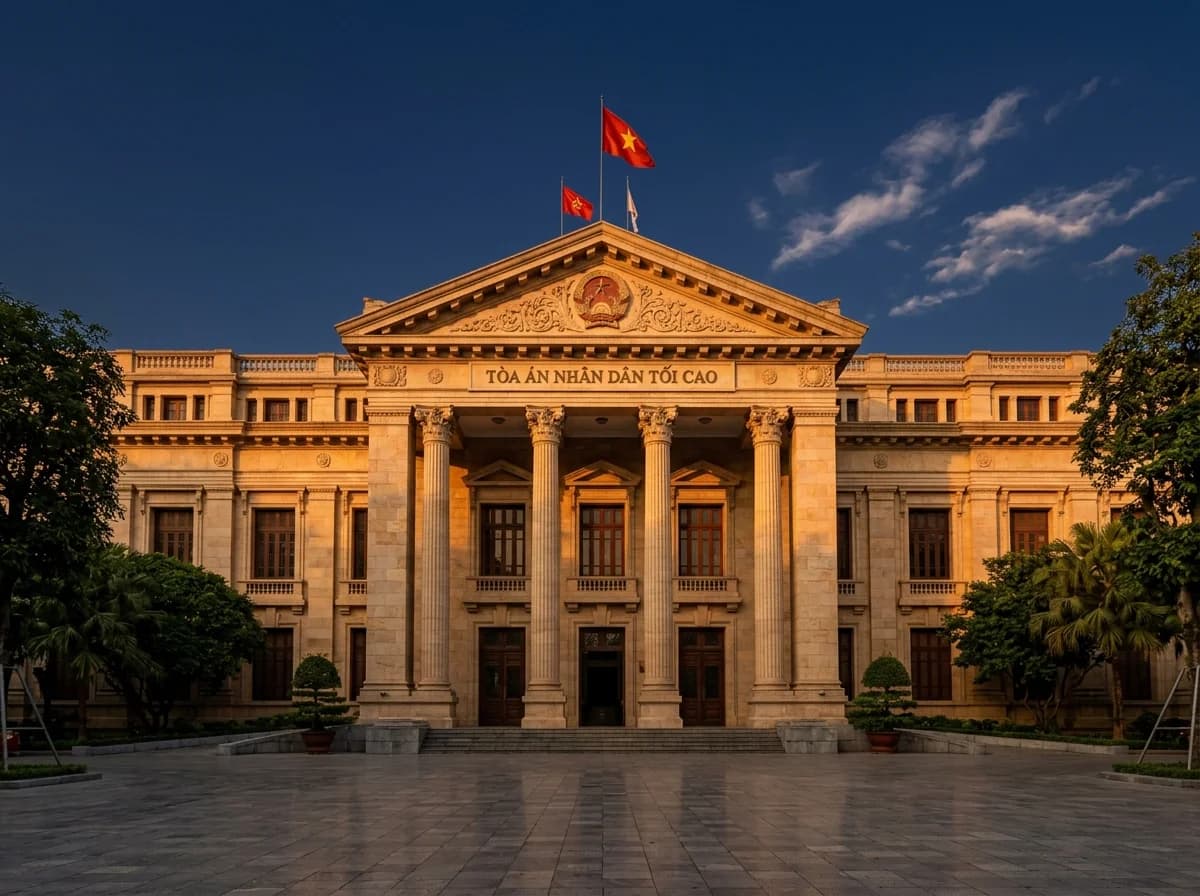
Vietnam's court system operates on the two-tier review principle and is organized under Law No. 81/2025/QH15: the Supreme People's Court, provincial people's courts, and regional people's courts, together with specialized courts. The Supreme People's Court belongs in this section. The entry below sets out the principal components, analyses the legal architecture, and flags the questions that typically arise in Vietnamese practice. For reference only; please verify against official sources. Specific citations (article numbers and instrument designations) will be added after qualified-lawyer review.
Position within the court system
Position within the court system is an important dimension to clarify within this material. This section focuses on the substance, scope, and constituent elements of position within the court system — read within the wider Vietnamese legal framework introduced above. The material is for reference and should be verified against the latest statutory text before being applied.
Structurally, the rules touching on position within the court system typically fall into two groups: general norms that set out principles and scope of application, and detailed norms that prescribe procedure and legal consequences. Ministerial guidance often fills in operational detail for typical fact-patterns the statute itself cannot fully anticipate. Readers should generally cross-read the parent provision and its implementing instruments rather than relying on either in isolation.
In practice, position within the court system is often a reference point lawyers, judges, and administrative officers return to repeatedly. Difficulties tend to arise not from the norm itself but from how it applies to a specific situation — especially where recently-enacted provisions have not yet generated precedent or internal guidance.
Core functions
An often-inseparable component of this material is core functions. This section addresses the structure, function, and scope of core functions within the wider legal system. A suitable reading of this material can help readers avoid common misconceptions and build a stable foundation for the more specialised material that follows.
The framework governing core functions generally tracks the broader principles of the civil-law tradition Vietnam follows — privileging the clarity of written norms, the central role of the legislature, and a supplementary role for adjudicative practice. The relevant rules tend to cross-reference multiple instruments, so reading any single provision in isolation may give an incomplete picture of its actual reach.
When applied to concrete situations, core functions often interacts with other parts — for example, supervisory and re-opening review. Judges, counsel, and researchers generally need to assess the related issues holistically rather than treating any one piece in isolation.
Supervisory and re-opening review
Supervisory and re-opening review is often regarded as one of the load-bearing pillars readers should internalise. The substance of this section touches both the pure-norm dimension and the enforcement dimension — not just what the law says, but how it tends to be applied. The distinction is especially salient in Vietnam, where guidance documents and the established practice of competent authorities often play a substantial supplementary role.
The legal framework relevant to supervisory and re-opening review generally sits in specialised statutory instruments, complemented by implementing decrees and circulars. This is a typical normative pattern in the civil-law tradition: abstract principles are operationalised through multiple successive instruments below the statute. Specific article numbers and named instruments are added in the qualified-lawyer review pass.
The practical importance of supervisory and re-opening review often comes through clearly when there is a dispute or where rights and obligations between parties need to be made determinate. Participants in the legal relationship generally need to clarify their own legal position before making decisions.
A legal norm only becomes meaningful when read within the broader system to which it belongs. — Apolo Editorial
Precedent and guidance on applying law
A pivotal element when studying this material is precedent and guidance on applying law. This section outlines the scope, governing principles, and notable limits of precedent and guidance on applying law so that readers can recognise the issue before drilling into any specific case.
In the organisation of Vietnamese law, precedent and guidance on applying law is generally reflected at multiple textual levels: foundational principles sit in a statute or code, detailed conditions live in a decree, and implementing procedure is set out in a circular. Readers should consult all three tiers to obtain a complete picture.
In practice, precedent and guidance on applying law typically calls for cross-disciplinary reconciliation — combining administrative-procedure rules, the powers of the relevant authority, and local adjudicative practice.
See also
For a complete picture, read the sister entries in the same cluster — especially Overview of Vietnam's court system, Provincial People's Courts, Regional People's Courts. When unfamiliar terminology arises, consult the glossary.
AI-drafted from an editorial outline, pending qualified-lawyer review. Specific statutory citations (article numbers and instrument designations) will be added in subsequent revisions. The information on this website is provided for reference purposes only, does not constitute legal advice, and does not create an attorney-client relationship. Apolo Lawyers disclaims liability for the application of this content to any specific situation.
Cite this entry
law.org.vn. (2026). "The Supreme People's Court". law.org.vn. Accessed 2026-05-28. https://law.org.vn/en/court-system/supreme-peoples-court
Sister entries
Overview of Vietnam's court system
The three-tier people's court hierarchy and specialized courts under Law No. 81/2025/QH15, their jurisdictions, and how cases move through the system.
continue →Provincial People's Courts
First-instance and appellate jurisdiction of provincial people's courts; their role in the three-tier hierarchy under Law No. 81/2025/QH15.
continue →Regional People's Courts
Regional people's courts — the new court level established under Law No. 81/2025/QH15 effective 01/07/2025, replacing district people's courts.
continue →Specialized courts
Specialized courts organized by subject matter — family, labour, administrative, economic, intellectual property — within the people's court system.
continue →